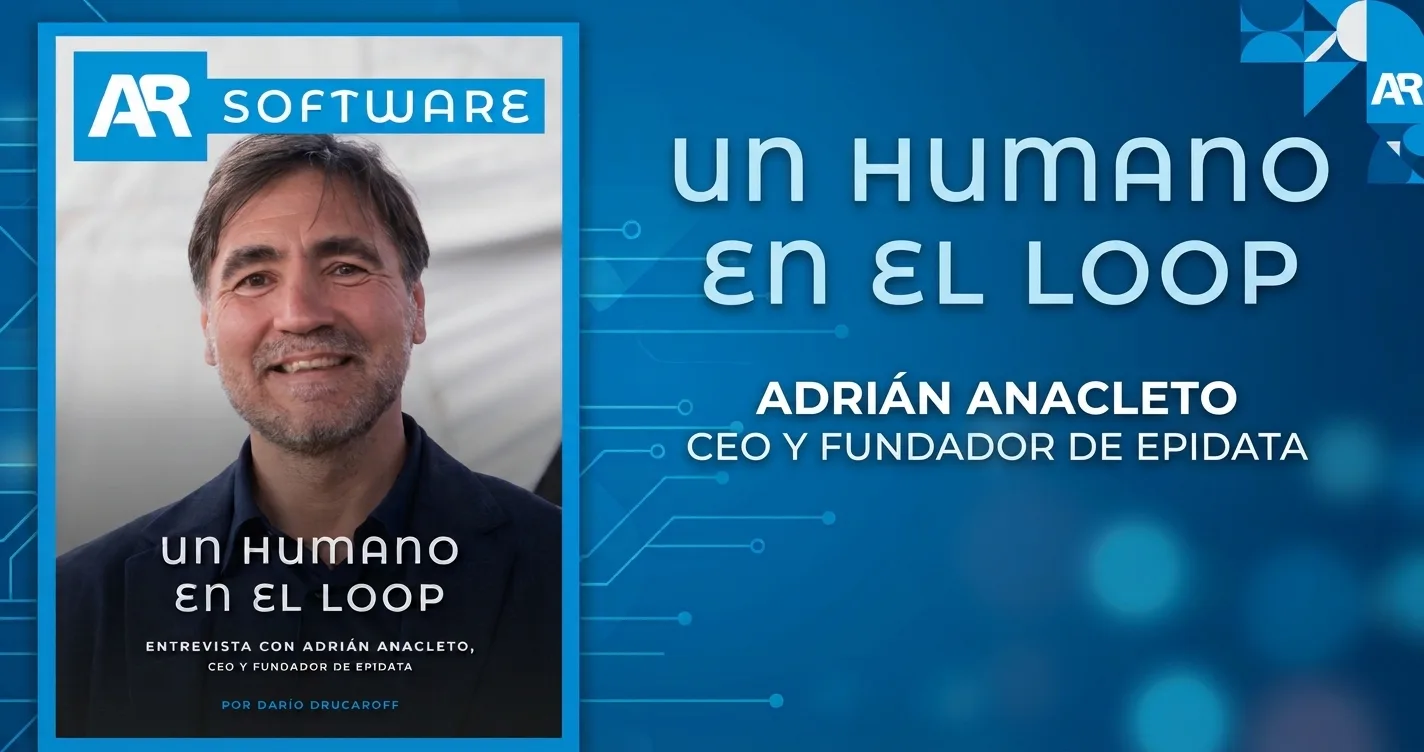

Column by Adrián Anacleto, CEO of Epidata, in CanalAR: Junior vs. Senior: the wrong question
In his column, Epidata's CEO argued that AI does not wipe out junior developers but relaunches them with new tools.
In an opinion column for CanalAR, Adrián Anacleto argued that the debate over whether artificial intelligence makes junior developers unnecessary starts from a poorly framed question.
Buenos Aires, July 8 – Adrián Anacleto, CEO of Epidata, a leading innovation outsourcing and software development company with presence in Latin America and the United States, wrote an opinion column for CanalAR titled “Junior vs. Senior: the wrong question,” in which he analyzed the place of entry-level programmers in the era of generative AI.
Anacleto draws on his twofold experience as a computer science lecturer and as the head of a company that works with hundreds of programmers in Latin America and the United States. He recalls that every disruptive breakthrough brings voices announcing the end of a profession, and that with generative AI it was the juniors’ turn. He compares it with the promise that a 200-hour course was enough to land a job as a programmer: a narrative he called a fallacy, although he acknowledged that it helped hundreds of thousands of young people in the region take their first step into software.
According to the CEO, in large innovation projects team structures have shifted from a pyramid with many juniors at the base to something closer to a diamond, with more weight on mid-level and senior profiles. But he warned that generalizing this trend is a mistake: “AI does not wipe out juniors. It relaunches them.” With tools such as Cursor, Copilot or Claude Code, he explained, newcomers can solve real, well-scoped problems from day one and find opportunities in startups, their own products, vertical solutions and automation for small and medium-sized businesses.
The column also warns against the opposite trap: romanticizing AI as a magic solution. Anacleto pointed out that enterprise software is deeply complex and that, when misused, AI amplifies that complexity. He echoed an idea from Santiago Ceria —Fangio was the best because, besides driving, he understood how the car worked— to stress that critical thinking is not enough without understanding the engine: “AI does not replace those who know. It replaces those who stop learning.”
Finally, he argued that there will always be more software to build and that stopping betting on juniors today means running out of seniors tomorrow: “The seniors of 2032 are today’s juniors.” For Epidata’s CEO, the right question is how to train juniors who use AI to learn faster, without using it as an excuse not to learn.
The same column was also published by Business Trend and Inversor Latam (in Spanish).
To read the full column (in Spanish), visit the CanalAR website.
About Epidata
We are a privately held global company and a leader in innovation outsourcing. At Epidata we transform organizations by combining software engineering, top talent and applied knowledge of the latest technologies, creating a real impact on people's lives.
Together with our clients and partners, we co-create technology solutions that drive innovation and transform businesses, institutions and cities.
Since 2003, we have been working with companies and governments, turning ideas into solutions.
We have strategic alliances with innovation leaders such as Salesforce, Mulesoft, Atlassian, Google, GitLab, UiPath, Datadog, Couchbase, Cloudera and AWS, among others.
Epidata - Deploying Ideas
www.epidata.net
Discover our Artificial Intelligence practice
Specialists, services and cases available in your country.